


The NEW/RECYCLED OM-3 by OM Systems
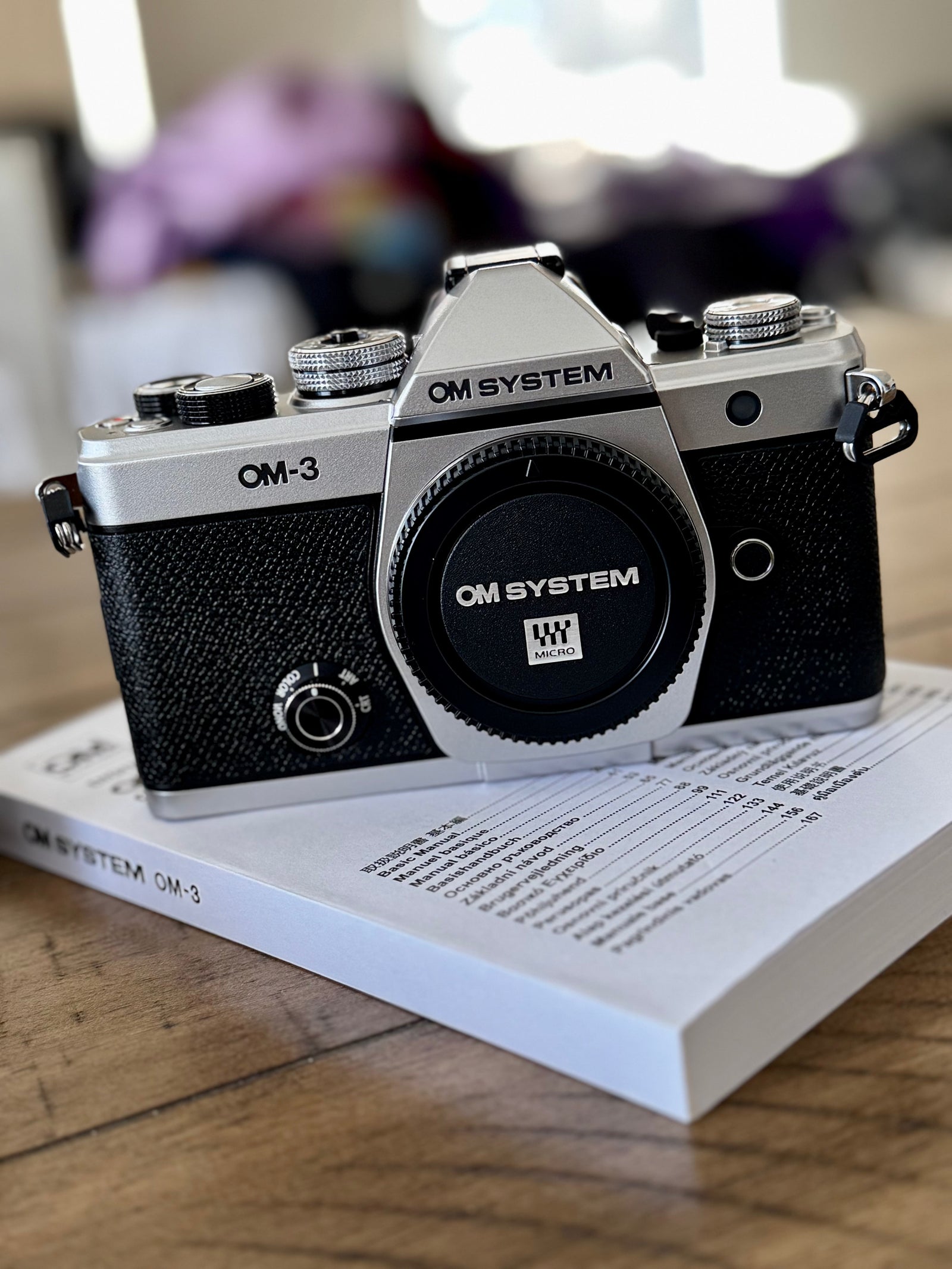
OM SYSTEMS OM-3 Review: A Real, Unfiltered Perspective
The OM SYSTEMS OM-3, launched in February 2025, has generated plenty of buzz, but after watching numerous YouTube reviews, I felt many of them missed the mark when it came to real-life experiences with the camera. While they may have been factually accurate, they lacked one crucial element: honesty. So, here’s my comprehensive and no-holds-barred review of the OM-3. I hope this helps you make a more informed decision if you’re considering investing in it.
Note: I am not affiliated with OM SYSTEMS in any way, nor did I receive any free equipment or payment for this review. The camera was purchased with my own money from a local camera supplier.

1. Design, Build, and Feel
One of the most appealing aspects of the OM-3 for me is its retro design, evoking the classic OM1 35mm film cameras from the past. OM SYSTEMS has done a great job blending nostalgic aesthetics with modern performance.
Upon purchasing the OM-3, I was pleasantly surprised by how close its weight is to the original OM1, with only a 20-30 gram difference. Whether this was by design or not, it’s a nice touch.
The camera body feels solid yet not too heavy, exuding a premium, well-crafted vibe. It’s reminiscent of the old-school “rock-solid” cameras of yore, unlike lighter models like the OM5, which feel less substantial. For its price, the build quality is top-notch, even edging out the flagship OM1 Mark 2 in terms of aesthetics and sturdiness.
What I don’t like:
Some of the rear buttons, particularly the “Menu” and “Info” buttons, feel small and a bit cheap. They could easily have been larger, and there’s enough space on the body to accommodate that. Also, the lack of a front finger grip and joystick feels odd. The front of the camera is flat, making it uncomfortable for long shooting sessions. While the rear thumb grip is decent, adding a slim, lightweight battery grip could improve handling.
Rating: 8.5/10

2. Battery Life
The OM-3 uses the same BLX-1 battery as the OM1 Mark 2, which has proven to be incredibly reliable. In my experience, this battery lasts throughout a full day of shooting, even in demanding conditions. The OM-3, with fewer power-hungry features, should offer even better endurance for long shoots.
Rating: 9/10

3. Viewfinder & LCD
Here’s where things get ugly for me.
The OM-3’s viewfinder is a significant downgrade from the OM1 Mark 2. While the OM1 features a 5760K dot high-resolution viewfinder, the OM-3 only offers a 2360K viewfinder. This drop in quality is noticeable, and it feels like a missed opportunity for OM SYSTEMS to keep up with the competition.
The downgrade feels particularly odd considering the camera’s price point. It’s a design choice that comes across as either cost-cutting or a simple oversight. For those upgrading from the OM5, this will be especially disappointing since it uses the same viewfinder tech.
On the plus side, the OM-3’s LCD is identical to the OM1 Mark 2, and it’s excellent. The LCD’s flip-out design adds to its versatility, making it a standout feature.
Viewfinder Rating: 5/10
LCD Rating: 9/10

4. Single Card Slot – Why OM... WHY?
A single SD card slot in a 2025 camera? That’s a dealbreaker for many. It’s baffling that OM SYSTEMS decided to include only one card slot in a camera priced over $3000 AUD. This feels like a cost-cutting move that doesn’t make sense for a camera in this price range, especially when competitors offer dual card slots at similar or lower price points.
Rating: 3/10

5. Colour Profile Dial
Here’s a feature that’s been getting a lot of attention: the colour profile dial. While the concept is great, it feels like OM SYSTEMS simply recycled the dial from the older PEN-F. It’s a nice touch for JPEG shooters, but it doesn’t live up to the colour profiles offered by competitors like Fujifilm. There’s no “wow” factor here, and it doesn’t seem like OM SYSTEMS went out of their way to create something innovative.
For those who love colour profiles, it’s a fun addition, but not revolutionary as advertised and promoted by other reviewers. Time to get a grip.
Rating: 5/10

6. Menu System
The OM-3 uses the same menu system as the OM1 Mark 1 and 2. Having used many cameras, I find the OM SYSTEMS menu to be relatively user-friendly. It’s easy to navigate once you get the hang of it, and you’ll quickly find what you need.
Fortunately, OM SYSTEMS didn’t revert to the OM5’s more complicated menu, which was a relief.
Rating: 8/10
7. Image & Video Quality
The OM-3 shares the same 20.4MP back-illuminated sensor as the OM1 Mark 2, and the image quality is top-tier. Colour reproduction is excellent, and the sharpness is on point. For stills, the camera delivers exactly what you expect from OM SYSTEMS – high-quality images with great clarity and detail.
While video isn’t my primary focus, the OM-3’s 4K UHD 60fps capability makes it a strong contender in the video space. The video specs are impressive, placing it on par with some of the best mirrorless cameras on the market.
Image Quality Rating: 9/10
Video Quality Rating: 8/10

8. Computational Modes
The OM-3 includes OM SYSTEMS’ renowned computational modes, such as Live ND, Grad ND, High-Res Mode, and Focus Stacking. These modes are fantastic for landscape and macro photography, allowing you to capture beautiful shots without additional filters or complex post-processing.
The dedicated button for these modes is a nice touch, though it’s more of a convenience upgrade rather than a groundbreaking new feature as was plugged heavily in all reviews I watched.
Rating: 8.5/10

9. Auto Focus (Slower?)
While the OM-3’s autofocus is good, it feels a bit slower compared to the OM1 Mark 2. On paper, the specs are similar, but in practice, I noticed a difference.
The camera’s autofocus may not be as fast as other high-end models, but it’s still reliable for most use cases. For sports and wildlife photographers, this might be a dealbreaker, but for general photography, it’s fine.
Rating: 7/10
10. Image Stabilisation
The OM-3 features OM SYSTEMS' excellent in-body image stabilisation (IBIS), offering up to 6.5 stops of stabilisation, which can be increased to 7.5 stops with compatible lenses. While it’s not as impressive as the OM1’s 8.5 stops, it still performs well for street and travel photography.
Rating: 8/10

11. Value for Money
At $3199 AUD, the OM-3 is expensive, and when compared to the OM1 Mark 2, which is only slightly more expensive at $3599 AUD, the OM-3 feels like it’s lacking in key areas, especially given the recycled components from the OM-5. I counted approx. 10 recycled parts from the OM-5 onto the OM-3 - that's a bit disappointing for me.
The camera’s design, performance, and handling are great, but the missing features like the single card slot and the outdated viewfinder leave me questioning its value. While it’s a solid camera overall, the price point feels a bit high for what you’re getting, when you consider many parts are recycled from the OM-5 and OM-1.
Rating: 6.5/10
Final Verdict
Overall, the OM-3 is a capable camera, but it doesn’t quite live up to its potential in my opinion. A few tricks missed that could have made this a real classic.
The retro design and image quality are its strong points, but it falls short in a few critical areas: the viewfinder, single card slot, and autofocus speed. If OM SYSTEMS can address these issues in future models, they could have a real winner on their hands.
Total Rating: 86.5/120 (72%)
While the OM-3 is not perfect, it still holds a lot of appeal for photographers who appreciate its design and retro charm. However, if you’re looking for a more feature-packed camera in the same price range, there are other options worth considering. If you are invested into the OM SYSTEM then the extra couple of hundred dollars would be better spent on the OM-1 Mark 2 in my opinion.
Who is the OM-3 suited to?
If you watched the OM SYSTEM promotions and the reviews online you would say its the young, hipsters, travelling backpackers ultimate camera, when in reality, as with all OM SYSTEM cameras it is suited to the photographer that needs light weight, weatherproofed cameras for travel and wildlife, but who can also afford the $3K + AUD price tag and who want to change from their heavy full frame systems into a reliable, light weight and sealed camera system.
For me this camera suits someone that is coming in new to the OM SYSTEM. And by that I mean, if you own an OM-5 or OM-1 Mark1 the upgrades that come with the OM-3 camera really for me don't hit the price tag mark.
If you are looking to get into the OM SYSTEM, which I would encourage, then this could be a great start to your line up.
What Photography is the OM-3 best for?
- Traveller - Light weight with one or two prime lenses
- Street Photographer - Light weight, looks good and with good ISIB will handle street photography well
- 2nd Camera for a wedding photography with single prime lens
- Landscape - if using a tripod and fixed primes lenses this will be a great little camera for landscapes
What Photography isn't it best for?
- Wildlife - Although it possess the required features, the handling of the slim body and no grip will drive you nuts - with the bigger tele-photo lenses it is simply too front heavy with no grip to help
- Sports - for the same reasons as wildlife
- Macro - whilst the features suit, the low resolution viewfinder will cause concern for macro-photographers as details in the viewfinder is very important for those macro subjects
For many years I feel OM SYSTEMS have been marketing their cameras to the wrong demographic, and sadly they continue to do so with the release of the OM-3. In my experience with running years of workshops and tours with customers who are looking to change from the heavy systems to the light weight ones, OM SYSTEM should be targeting this crowd to put their very good cameras in the hands of experienced, but somewhat older photographers who simply don't want heavy gear anymore.
I hope this review helps you in making an informed decision about the OM-3. Let me know your thoughts in the comments!

Interesting comment about the AF, I went from an OM-1 Mk1 to an OM-3 and thought that the AF with my dog running towards me was performing worse than it did with the OM-1. Could you give some examples as to why you thought it was slower too?
Great review. It confirms my reason not to upgrade from em5iii (the OM5 offered no real roi/upgrade for me). No increase in pixels, auto focus not up to speed, recycled parts, viewfinder not updated, very expensive for what it doesn’t offer, no luts, no open gate….Sigh, I have given up on Oly / OM.
I tried on OM-3 in a bricks and mortar shop attached to my Panasonic 100-400. I’m not sure of the ‘drive me nuts’ factor of not having a grip. It felt fine to me as most of the weight is supported by my left hand holding the lens. However, given its specs I will hold off until I can get one for closer to $2K…may not happen…given the proximity of the price to the MkI and MkII. I have a G9II which is great for birding but I have a notion to grow a man-bun (which will be a struggle given my baldness) and use an OM-3 for street and travel with the occasional bit of birding when travelling.
One other drawback not mentioned in your review is the need to grade the footage when using 10 bit video which is reportedly much sharper than the 8 bit….though my G9II is great for video…cheers, Don.
Good honest review. While I have not had the chance to see the OM3 in person yet, your evaluation rings true from everything I’ve gathered. I know for a fact that OM System has paid some (or maybe many, or even all?) of the YouTube camera influencers to promote the OM3, because I’ve seen at least one of them openly admit to it. Money, free cameras, access… all things that influence opinions even when people would like to be honest. It’s just part of human nature. Anyway, I appreciate you pointing out the pretty obvious flaws as well as the many strong points. I might’ve been inclined to buy the OM3 if it had the same EVF as the OM1, or even just a 3.7m dot EVF. I really like a nice viewfinder, and a 2.3m dot EVF on a $2000 camera in 2025 is just extremely disappointing. And before people say it doesn’t really matter… it does matter for various types of photography as Cam pointed out, as well as just the joy of having a clearer view of what you are photographing. As it is, the OM3 is maybe a $1500 camera, and even then I would have to think about it.
Thanks Cam, a thorough, genuine review. Like Mal I briefly considered the OM-3 as a potential second body but not at a price point where the OM 1 mk1 at nearly $1000 less is a far better proposition even if it is a little long in the tooth.
Leave a comment